
Flights from Delhi or Bengaluru, while they may still fly over Iran, depending on the route, have alternative paths that may take them through Central Asia or northern routes.

The United States Central Command announced strikes against Iranian military targets, including air defence and communication sites, in retaliation for alleged attacks on commercial shipping and US personnel. However, Iran's Foreign Ministry claims these strikes caused over 50 civilian casualties at a wedding and vowed a firm response. Iran's state media also reported retaliatory ballistic missile and drone attacks on US bases in Jordan and Bahrain, claims which were partially corroborated by Kuwait and Jordan reporting intercepted drones and missiles.

Media reports based on intelligence sources say nearly half of Iran's missile launchers remain intact, while thousands of one-way attack drones are still part of its arsenal even after continuous strikes targeting military infrastructure over the past five weeks.

The US military carried out 'self-defence strikes' targeting Iranian missile launch sites and boats near the Strait of Hormuz, even as President Trump announced progress in ceasefire negotiations, stating Iran's enriched uranium will be 'turned over' or destroyed.

The Iranian terrorist regime launched a long-range missile for the first time since the start of Operation Roaring Lion that could reach a distance of ~4,000 km, Israel said.

Iran has restored access to a significant portion of its underground missile infrastructure following months of excavation and repair work, highlighting the limits of US bombing strategy.

The USS Abraham Lincoln has been operating in the Arabian Sea since the end of January.

United States Central Command (CENTCOM) forces have conducted a 'heavy wave of strikes' against numerous Islamic Revolutionary Guard Corps (IRGC) targets in Iran. This action was a direct response to attempted Iranian missile strikes on US forces in West Asia, which were successfully intercepted. The strikes targeted IRGC military command centres, missile and drone facilities, coastal surveillance, and maritime capabilities, aiming to reduce threats posed by Iran and its proxies. US President Donald Trump also issued strong warnings to Tehran, linking the escalation to a recent drone strike on an LNG vessel in Egypt's Damietta Port.

Iran's Islamic Revolutionary Guard Corps (IRGC) claims to have captured a US unmanned submersible near the Strait of Hormuz and launched ballistic missile strikes against a US airbase in Jordan and two US Navy destroyers. These actions are stated as retaliation for recent US attacks on Iranian oil tankers. The US Central Command (CENTCOM) had previously reported destroying Iranian crude oil carriers after IRGC missile attacks on US warships. The escalating tensions have led to regional air defence activations and warnings to tanker crews.

The United States has reportedly conducted a clandestine military operation targeting Iran's Qeshm Island, part of a series of limited attacks against Tehran. This strike occurred on Monday, shortly after US President Donald Trump suggested a deal with Iran was possible, despite ongoing military actions. US officials indicate these strikes are kept minimal and secret to avoid escalating to a wider military campaign. The incident follows previous US actions and Iran's report of capturing a US drone.

The American military's air-defence missile inventories, including Patriot and THAAD interceptors, are significantly depleted due to the ongoing five-month confrontation with Iran. A CSIS assessment reveals a steep drop in reserve stocks, raising concerns about the US's capacity to maintain Middle East operations and address other global security challenges. This depletion could force the US and its allies to take higher operational risks.

Iran's Islamic Revolutionary Guard Corps (IRGC) Aerospace Force claimed to have fired several ballistic missiles at a US aircraft carrier and a destroyer, alleging the warships were harassing Iranian ships and participating in a naval blockade.

A large fire was reported on Saturday night at a strategic complex near Haifa in northern Israel after Iran launched a barrage of missiles and drones, MEHR News Agency reported, citing local media.
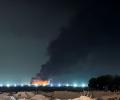
Iran's Islamic Revolutionary Guard Corps (IRGC) says its forces carried out a drone attack targeting a US radar system located at a military base in Bahrain, according to an official release broadcast by Iranian state media.

The Iranian embassy also posted a video purportedly showing the aftermath of the strike, with plumes of smoke visible.

The incident came shortly after a spokesperson from Iran's military warned that Tehran could target ports and docks in the United Arab Emirates following recent United States strikes on Kharg Island, a key hub for Iran's oil exports.

The United States Central Command (CENTCOM) has launched self-defence strikes against multiple targets in Iran, citing ongoing Iranian aggression. This action has led to Iran's Red Crescent placing emergency centres on high alert amidst reports of explosions in several Iranian cities. Concurrently, Iraqi media claims Iran retaliated with a missile strike on a US air base in Erbil.

The IRGC said the strikes were conducted in support of offensives by Hezbollah and residents of southern Lebanon, and described them as the beginning of a series of pre-announced operations against Israel.

In a clear message to international observers, the strategic site was pointedly "described as "the tip of the iceberg" regarding the nation's hidden arsenal.

United States Secretary of War Pete Hegseth has rejected a CNN report claiming that the Pentagon's missile defence stockpiles have fallen to 'dangerously low levels' amid the conflict with Iran.

Iran's Islamic Revolutionary Guard Corps (IRGC) has launched missile and drone strikes on four US military bases in Kuwait and Bahrain. This action is in retaliation for recent American strikes against targets in Iran, which the IRGC condemned as a "violation of commitments" and an "anti-civilian act." The IRGC has warned of an expanded "crushing response" if US aggression continues.

According to an official Iranian military statement, Qader anti-ship cruise missiles were launched at the carrier, forcing it to alter its position in the region.

Iran's Islamic Revolutionary Guard Corps (IRGC) has claimed responsibility for missile and drone strikes on US military installations in Bahrain, describing the operations as the second phase of its retaliatory campaign. This announcement follows US Central Command (CENTCOM) confirming its own large-scale offensive targeting Iranian military infrastructure.

Saudi Arabia and the UAE are actively pushing Trump to take the war to its bitter finish and 'erase' Iran's presence in the geopolitics of the region. Simply put, the two most powerful Sunni Arab oligarchies are on the same page as Israel. Such interference increases the risk of a breakdown in dialogue between the US and Iran, points out Ambassador M K Bhadrakumar.

The IRGC also warned residents to evacuate areas near military bases, security centres and government facilities.

Hours after US President Donald Trump on Wednesday said that the ceasefire deal with Iran was "over", the US President indicated that Washington could launch another round of strikes against the Islamic Republic, following strikes on Tuesday, saying it had already hit Tehran "very hard" and warning of further attacks.

Iran's Islamic Revolutionary Guard Corps (IRGC) on Thursday claimed it had struck the US Al-Azraq air base in northern Jordan with 10 ballistic missiles on what it described as an "enemy command and control centre in West Asia" in retaliatory strikes in response to a recent attack on Tehran by Washington.

Iran has launched a fresh wave of missile attacks against Israeli and United States-linked targets as the Islamic Revolutionary Guard Corps (IRGC) said it fired some of its heaviest missiles in the latest phase of its retaliatory campaign, while Israel Defence Forces alleged that many of the projectiles carried cluster bomb warheads.

The Israel Defence Forces (IDF) confirmed the missile launches in a statement on Telegram, noting that defensive systems were actively operating to intercept the threat.

The IRGC accused US and Israeli forces of using civilians as 'human shields' and warned of continued attacks.

Dimona and Ahad came under intense Iranian missile fire over the weekend as the conflict entered a far more volatile phase. These photographs capture the aftermath of the strikes -- thick smoke rising over the cities, emergency teams rushing to the scenes and residents caught in the chaos that followed.

The Kuwaiti Army reported intercepting hostile missile and drone attacks, while tensions escalate between the US and Iran with reported strikes and confrontations near the Strait of Hormuz.

Chief of Defence Staff General NS Raja Subramani highlighted on Monday how artificial intelligence, satellite-based intelligence, and mass-produced drones are fundamentally altering modern warfare. He warned that the entire geographical expanse of a nation is now a potential battlefield, making everyone vulnerable. The CDS emphasised the changing economics of warfare, the growing contest for technological superiority, and the expansion of the battle space as key determinants of future conflicts.
New photographic evidence and a Pentagon inspector general's report confirm extensive damage to US military installations across the Middle East due to Iranian missile and drone strikes. The report details billions in financial costs, structural losses to hundreds of buildings, and damage to dozens of aircraft, contradicting previous assertions about US military readiness and ordnance stockpiles. The conflict also led to disruptions in the Strait of Hormuz, impacting global oil prices.

The strike came amid the peace deal talks between two countries and a fragile ceasefire.

US missions across West Asia have issued a security alert advising American nationals to "exercise heightened vigilance" due to Houthi attacks against Saudi Arabia and the potential for Iran and its allies to target US interests. The advisory warns of potential travel disruptions and escalating hostilities, linking the Houthi actions to Iran's regional network and the ongoing US-Iran conflict.

The United States has launched a fresh wave of precision strikes, hitting approximately 90 Iranian military targets deep inside Iran, further intensifying a rapidly expanding regional conflict, with Tehran warning of severe retaliation.

The United States launched military action against two Iranian launch systems on Larak Island, prompting Iran to claim retaliation with ballistic missile launches targeting two US air bases in Jordan.

US Central Command (CENTCOM) forces conducted additional strikes against multiple targets in Iran, on Saturday (local time), at the commander in chief, US President Donald Trump's direction.

Kuwait's air defence systems engaged 'hostile aerial targets', Jordan intercepted four missiles, and Bahrain sounded warning sirens after Iran launched retaliatory strikes targeting US military installations in the region.
